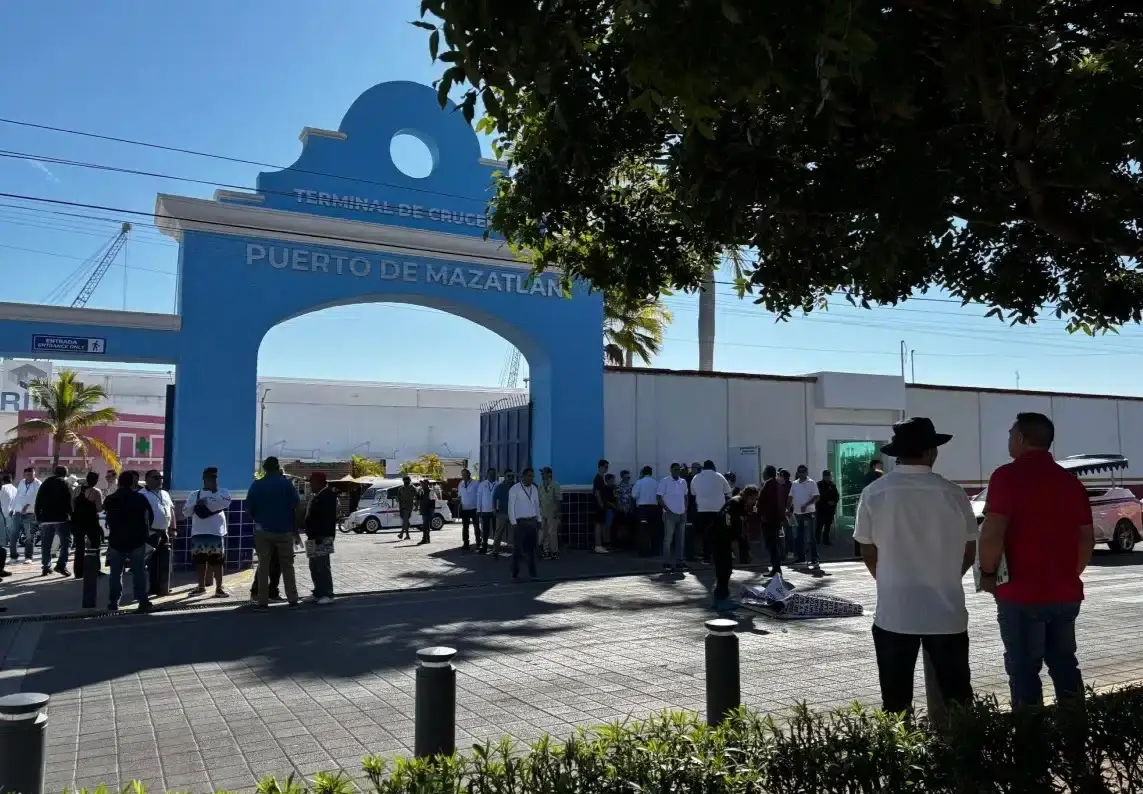

The idea of converting the port of Mazatlán into a departure point for international cruise ships has been floating around for years between plans, official documents, and environmental resolutions. The Mazatlán Comprehensive Port Authority (API), now the National Port System Authority (ASIPONA), has submitted the same project three times, under different names and with different modifications, in an attempt to obtain the environmental authorization that would allow it to begin construction.
On August 10, 2021, the Mazatlán API submitted its Particular Environmental Impact Statement (MIA-P) to the General Directorate of Environmental Impact and Risk (DGIRA), under the name: “Tourist Cruise and Ferry Terminal, Mazatlán, Sinaloa.”
The project contemplated building a 2.34-hectare maritime terminal in the southern area of the port area, including a shopping plaza, a food market, a lobby, an esplanade, retail spaces, and parking on a surface that was currently serving as a parking lot.
However, SEMARNAT denied the authorization through official document SGPA/DGIRA/DG-05384-21, dated October of that year. The reason was strictly administrative: the API failed to publish the project summary within the five-day legal deadline established by Article 34 of the General Law on Ecological Balance and Environmental Protection (LGEEPA). The publication in the newspaper Noroeste took place on August 22, 2021, when the deadline expired on the 17th.
This oversight was sufficient for the DGIRA to deny the request, based on Article 35, Section III, paragraph a) of the LGEEPA.
On February 17, 2022, the API resubmitted the project, keeping the same name but with a new file: “Environmental Impact Statement, Specific Modality, for the Cruise and Ferry Tourist Terminal, Mazatlán, Sinaloa.”
This version expanded the area to 23,475 m², including commercial areas, a food hall, a lobby, terraces, parking, and internal roads.
Although the abstract was published on February 19, 2022, the DGIRA again denied authorization through resolution 09_MP-0210/02/22, arguing that the environmental statement did not guarantee compatibility with ecological and urban planning nor did it sufficiently detail the cumulative impacts on the coastal ecosystem.
In its third attempt, the API submitted a corrected version of the MIA-P, maintaining the name but updating the plans and descriptive reports. This time, SEMARNAT granted the environmental authorization through Resolution 09_MG-0338/02/22, subject to compliance with a series of mitigation measures, including:
The authorization establishes 24 months for construction and 50 years for operation of the terminal, with semiannual reports to PROFEPA and an Environmental Monitoring Program. However, there is no public record of construction progress or evidence that ASIPONA has submitted such reports.
When asked about the issue, Renato Ocampo Alcántar, SEMARNAT’s delegate in Sinaloa, explained that ASIPONA projects, since they are under the jurisdiction of the Navy, are not reviewed by state representations but directly by the Secretariat’s central offices in Mexico City.
“The environmental impacts of municipalities, states, and the federation, as in the case of ASIPONA, are reviewed and authorized by the central offices. They do not go through state representations,” he noted.
According to the official, previous requests may have met the technical requirements, but lacked the necessary budget to move forward.
Currently, open-air spaces are limited for the flow of tourists who come to enjoy the port.
“Surely what happened is that they submitted the project, conducted the corresponding studies, but weren’t authorized the funds. It’s very important that they had them, because the studies are accompanied by a budget.” He commented that the new project announced by the governor could be linked to those previous attempts by ASIPONA. “The goal has always been for cruise ships to extend their stay in Mazatlán, for tourists to disembark, sleep, and consume more. This is likely due to the projects being brought forward by ASIPONA, which already has the concession for those lands granted by SEMARNAT,” he explained.
The delegate also clarified that if the works are carried out within the already impacted area, a new environmental study might not be required.
“Perhaps it’s just a terminal remodeling and doesn’t necessarily require a new environmental impact. But we’d have to see what the project is, I don’t know,” he clarified.
Finally, he acknowledged that the centralization of environmental procedures has caused delays in both central and state offices.
Home Port: The first terminal of its kind in Mexico
On August 25, 2025, Governor Rubén Rocha Moya relaunched the project under a new name: “Home Port Mazatlán,” with the ambition of turning the Sinaloa port into the first point of origin for international cruises in Mexico.
Facade of the new Mazatlán Cruise Terminal and Home Port.
Registered with Fonatur, the project proposes an estimated investment of between 400 and 450 million pesos and a design of 9,453.81 m², designed by Oslander Arquitectos. The plan includes renovated entrances, ticket offices, commercial areas, and recreational areas, but so far lacks an executive plan, construction schedule, or defined financing.
Inside, galleries are planned between the recreational spaces.
“We’ve already sent the project to Fonatur. Of course, we need a well-designed, attractive terminal where passengers can get off, but also get on,” said Rocha Moya at his weekly press conference.
In essence, Home Port is a political version of the project that API submitted three times to SEMARNAT. The difference is that this time there’s no mention of the MIA or whether the 2022 authorization is still valid or will be modified.
“It would be the first in Mexico.”
Asked about the project’s progress, Sinaloa’s Secretary of Tourism, Mireya Sosa Osuna, clarified that Home Port and the investment in the terminal are two different things.
“They are two different things. One is the Home Port, and a Home Port can simply be an investment in the terminal, approximately 400 to 450 million pesos. The port of Mazatlán, ASIPONA, if decided within a month, can be a Home Port… it has nothing to do with the additional investment, but rather with relationships with shipping companies and deals that are worked out well in advance,” he explained.
Common areas of the new project.
Sosa Osuna added that the negotiations are moving forward in coordination with Fonatur, the Federal Ministry of Tourism, and Governor Rubén Rocha Moya himself, with the support of President Claudia Sheinbaum Pardo.
“We continue working and following up because it is one of the main tasks the governor has given us. This will have a drastically positive impact on Mazatlán, increasing the average stay, air connectivity, and the entire tourism value chain.”
The secretary explained that the new terminal, which includes 6,017 m² of construction and 3,300 m² of parking, will allow for simultaneous reception of large vessels, reducing wait times and increasing the port’s competitiveness compared to other international destinations.
The dining area and rest areas of the new terminal.
The triangular design, inspired by the bow of a cruise ship, seeks to become a visual landmark for the city. “It will raise the standard of service, expedite boarding, and project Mazatlán as a modern, world-class destination,” she stated.
She explained that a new environmental study would not be necessary, as it would be carried out on an already impacted area.
“There is a study approved by CONANP; it’s the same area, and nothing will be modified. It could be a reality. We will continue working, and as a Mazatlan resident, of course I want this to be achieved.”
In four years, Mazatlán’s tourist terminal has undergone three environmental assessments and a new political re-launch. Of files 25SI2021H0047, S12022T0005, and MG-0338/02/22, only the latter received authorization. Its execution, however, remains uncertain.
Finally, the Mazatlán National Port System Administration, S.A. de C.V. (ASIPONA) responded to ESPEJO that the project is being led solely by the Sinaloa State Government.
“They tell me that this project is being presented by the state government. They could provide you with information related to what you’re looking for,” the coordinator responded.
Source: revistaespejo