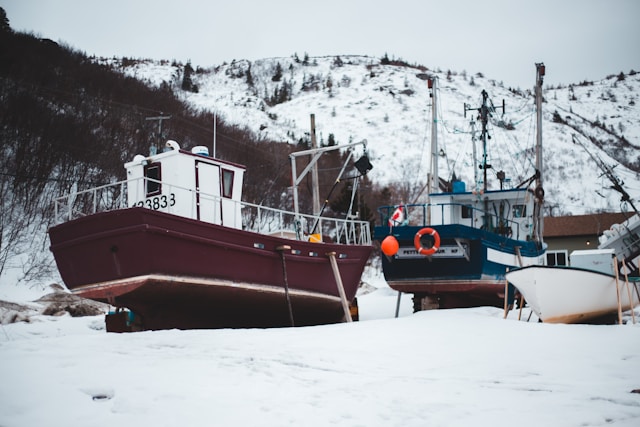

The transition from the water to the dock or dry storage is a shift from one environmental stressor to another. While the hull is no longer battling the immediate friction of the waves or the corrosive nature of salt water in motion, it is now subject to the slower, more insidious threats of stagnant moisture, UV degradation, and temperature fluctuations.
Protecting a boat during the off-season takes a lot more than just putting it somewhere dry and secure. Static environments can be just as damaging as active ones.
- Addressing the Hull’s Micro-Porosity
There is a common misconception that fiberglass and gelcoats are impenetrable. At a molecular level these surfaces are surprisingly porous, and when a boat is pulled from the water and left in an environment where humidity levels fluctuate, moisture can become trapped within these microscopic pores.
In colder climates, this moisture undergoes a freeze-thaw cycle – just like the rocks we learned about in geography class – expanding and contracting until it creates “osmotic blistering.”
To prevent this, the cleaning process must be surgical. Removing the salt film is the first step, but the second is ensuring the hull is completely desiccated before any covers are applied – and this is also a good time to inspect for “gelcoat craze” – the tiny spiderweb cracks that act as highways for moisture.
Sealing these entry points in the autumn, rather than waiting for the spring rush, is the difference between a simple polish and a structural repair.
- Fortifying the Exterior Barrier
The off-season is the ideal window to assess the integrity of the boat’s skin. For those who keep their vessels in dry stack or trailer storage, the sun remains a constant adversary. UV rays don’t just fade the graphics; they break down the chemical bonds of the gelcoat, leading to “chalking,” which leaves the surface vulnerable to staining.
Applying a high-quality sealant or a fresh protective coating is essential. While the decision to buy marine paint is often framed as a springtime ritual, applying a barrier coat before the first freeze can prevent moisture from expanding within the hull’s pores during the winter, because it ensures that the hull remains “hydrophobic,” shedding water and melting snow rather than allowing it to sit and penetrate the surface.
- Regulating the Internal Microclimate
The interior of a boat is a confined space that can easily become a greenhouse for mold and mildew. When a boat is wrapped too tightly without adequate airflow, the greenhouse effect takes over. As the sun warms the cover during the day and the air cools at night, condensation forms on the underside of the deck and drips into the upholstery.
Smart off-season protection involves creating a breathing environment. Using high-quality vents in shrink-wrap or custom covers is a start, but many owners are moving toward active moisture absorbers or solar-powered fans. The goal is to keep the internal dew point below the level where spores can thrive. This preservation of the interior is often what determines the long-term “feel” and value of the boat.
- Shielding Against UV and Atmospheric Debris
Even if a boat is stored under a roof, atmospheric pollutants and dust can act as abrasives. In many coastal regions, the off-season air still carries enough salt to facilitate corrosion on exposed stainless steel and aluminum fittings.
Experienced mariners focus on the waterline and areas prone to osmotic blistering, ensuring the vessel remains dry internally even when the external air is heavy with sleet. Beyond the hull, protecting the brightwork—the wood and metal accents—with a sacrificial layer of wax or a specialized wrap prevents the pitting and “silvering” that can take weeks of labor to reverse once the season begins again.