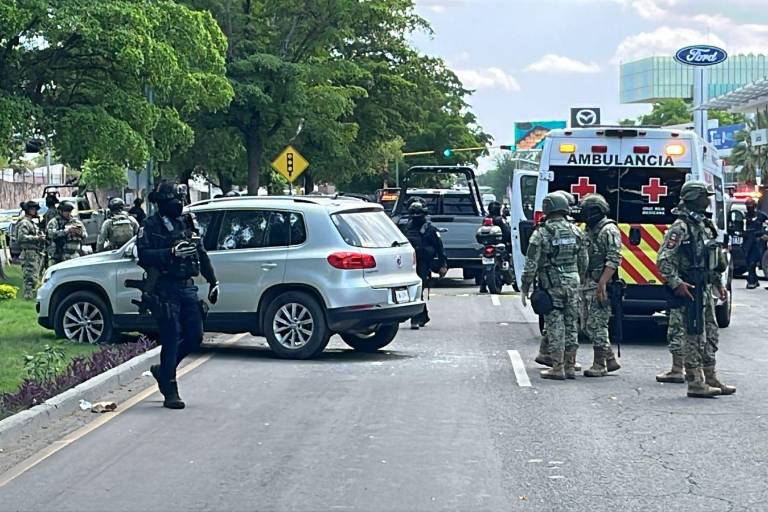
Since 2024, violence associated with organized crime disputes in Sinaloa has resulted in the deaths of at least 81 members of security forces, including municipal, state, and federal police officers.
In the first 23 days of 2026, six members of the security forces were killed in the state, four of them in Culiacán.
The most recent case was that of a motorcycle patrol officer from the Jaguar Group of the Mazatlán Municipal Police, who was attacked while working in the Loma Bonita neighborhood. His case was registered in the investigation file as “homicide by assault on an authority figure,” but it was not included in the monthly homicide count.
With these incidents, the number of municipal and state police officers killed in Sinaloa rises to 66, according to tracking by Noroeste.
This record is supplemented by data contained in an official document validated by the Federal Center for Criminal Intelligence of the Attorney General’s Office, which details that between September 9, 2024, and November 10, 2025, at least 12 armed attacks were reported against personnel of the Mexican Army and the National Guard in Sinaloa.
These attacks resulted in the deaths of 15 soldiers, bringing the total number of members of municipal, state, and federal law enforcement agencies killed in the state during that period to 81.
The data reflects that the attacks have not been limited to a single level of government, but have also targeted local police and federal forces deployed in the state at different times during the security conflict.
In the case of the events recorded in 2026, the concentration of attacks in Culiacán coincides with the persistence of violence in the state capital, although historical records show that attacks against security forces have occurred in different municipalities and regions of Sinaloa.
The head of the State Public Security Council, Miguel Calderón Quevedo, stated that strengthening the guarantees inherent to police work, particularly regarding equipment, benefits, and operational capabilities, is an issue that must be seriously analyzed to protect public security personnel.
“There are guarantees inherent to the role that involve increasing capabilities in terms of equipment and benefits; that is, ensuring that public security personnel have a series of guarantees related to their daily work,” he said.
The head of the CESP indicated that while the proposal to allow officers to carry their weapons off-duty is interesting, the main emphasis should be on strengthening equipment while on duty, since a high percentage of attacks against police officers occur while they are on active duty.
“We think it’s interesting; it should be evaluated, and we should consider the risks and drawbacks. But fundamentally, we need to strengthen their equipment while they are on duty; a high percentage of these victims have unfortunately been attacked while on duty, and not so much while off duty,” he pointed out.
Regarding the approved budget, Calderón Quevedo acknowledged that, although it doesn’t reach the level considered necessary, it does represent a larger increase than in previous years, with the expectation that it will lead to better conditions for police work.
“It wasn’t at the level we needed, but it was a budget increase that jumped more than in previous years. Hopefully, all of this will translate into better protection for the daily work of police officers,” he said.
Finally, he maintained that society owes a historical debt to the police and emphasized the need to restore the prestige of this profession, as well as to support both the families of fallen officers and those still on active duty.
“We mourn the deaths of all these members of the police forces, but along with that, we must support their families, the orphans, the widows, and also support those who are currently serving. This can also be a mechanism of social protection,” he concluded.
Source: noroeste