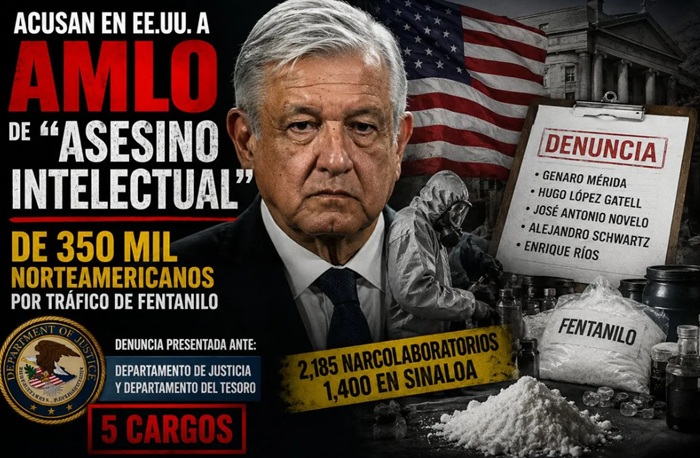

WASHINGTON, D.C. — Former Mexican President Andrés Manuel López Obrador is facing severe legal accusations in the United States, where critics are labeling him the “intellectual author” behind the fentanyl-related deaths of 350,000 Americans.
According to explosive reports, five formal criminal complaints have been filed with the U.S. Department of Justice and the Department of the Treasury, alleging systematic government collusion in cross-border drug trafficking.
The legal complaints, spearheaded by activist and former public official Simón Levy, claim that López Obrador’s administration actively weaponized Mexico’s primary health regulatory agency, the Federal Commission for the Protection against Sanitary Risks (Cofepris), alongside Mexican customs. The filings argue that these agencies bypassed critical regulatory safeguards to allow the mass influx of precursor chemicals required to manufacture fentanyl.
According to the documents, the strategy allegedly funneled chemical precursors directly to 2,185 clandestine narco-laboratories across Mexico, with an estimated 1,400 located in the state of Sinaloa. The complaint highlights a massive discrepancy in official data: while Cofepris reported importing only 7.2 kilograms of fentanyl from China between 2021 and 2024, U.S. Homeland Security seized 34 tons of the substance at the border—an amount equivalent to roughly 17 billion lethal doses according to DEA standards.
The filings place high-ranking former officials under intense scrutiny alongside the former president. Among those named in the legal actions are former pandemic czar Hugo López-Gatell, José Antonio Novelo, Alejandro Schwartz, and Enrique Ríos, an official accused of signing off on key import permits.
Central to the burgeoning case is General Gerardo Mérida, who reportedly surrendered to U.S. authorities in New York and gave his first testimony last week. Sources claim General Mérida provided federal prosecutors with an abundance of evidence detailing how the Mexican Secretariat of the Navy, which oversaw customs and Cofepris during the latter half of the administration, intentionally left entry points unmonitored. Five former Cofepris employees have reportedly also cooperated as whistleblowers and been relocated outside of Mexico for their safety.
As federal judges in the United States begin a 60-day review period to analyze the newly submitted evidence, legal experts note that because fentanyl has been designated a “lethal weapon” and trafficking syndicates are classified as terrorist entities under U.S. guidelines, the mounting charges carry significant international legal weight, potentially opening the door for future extradition requests.
Source: La Carpeta Purpura