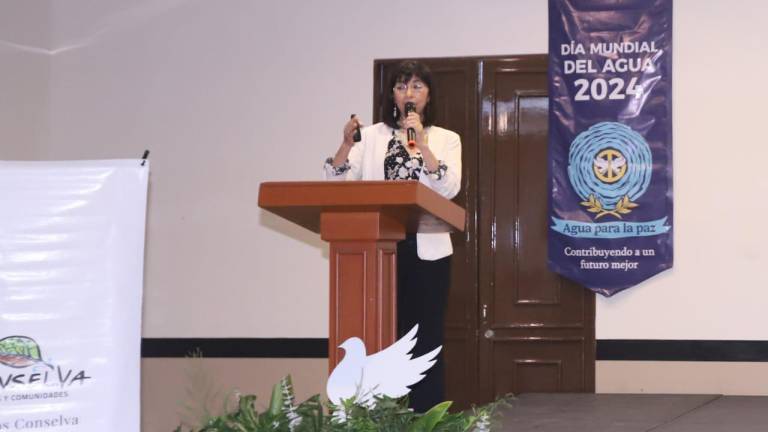

Although Sinaloa is the state of the 11 rivers, this does not guarantee that there is enough water, and currently, 96.3 percent of the territory of the entity is in drought, stated the director of Conselva, Costas y Comunidades, Sandra Guido Sánchez.
While delivering the conference “Drought in Sinaloa. What to do to make the water reach?” organized by the Municipal Board of Potable Water and Sewerage of Mazatlán as part of the celebration of World Water Day this March 22, she added that this civil association builds technically supported solutions with a lot of science, technology, and academia, socially endorsed, but it is necessary that they be implemented through public policy, otherwise, we would be talking about very nice technical reports on the desk and the computer if nothing moves.
“We need public policy for the solution to be implemented and to work in the long term, that’s what we do, so we are in Sinaloa, a state that every day, until recently I am seeing those commercials of the 11 rivers and the abundance of water and our dams and it’s like a fantasy that we have created, which is already about 50 years old and we still think that we are the state of the 11 rivers, because we are, but the abundance of water is something else,” added Guido Sánchez.
“Right now, at this moment, 96.3 percent of the state is in drought, there are four municipalities that are at the highest level, which is B 4, exceptional drought, and we are talking about municipalities like Cosalá and Culiacán that are in exceptional drought; San Ignacio, Choix, and El Fuerte that are already in exceptional drought and if you notice, it is exceptional drought right where the dams are, so that’s the size of the problem,” continued the general director of Conselva, Costas y Comunidades.
“The rest of the municipalities are in B 3, extreme drought, which is the case of Mazatlán at this moment.”
She emphasized that it is not the first time that Sinaloa and the country find themselves in this situation, it has been worse, but why it is so worrying right now, because it has never been like this since January.
“Why we start to worry, because we are on World Water Day in March, well because we had never been like this since January, these are the scenarios we had in May, right now this has been presented since January and if not here is Jumapam who can tell me that they started to send water trucks, there is Ceapas that started to send water trucks to supply water to some places,” she continued, among other points.
“The speed of droughts is increasing and not only that, droughts are lasting longer, right now we have them since January and it will last until June or July because the monsoon is extending until July, but they are of greater intensity and coverage, the Bank of Mexico has some studies, some analyses, that are analyzing the impact on the Gross Domestic Product of droughts, we are already talking about the economy of an entire country and there are small areas that analyzed the droughts, each time the speed is increasing.”
She recalled that in Sinaloa there have been several episodes of drought, but the Bank of Mexico is right when it says that they are becoming more frequent and in the case of the Sinaloan entity, according to data from the National Water Commission, there was a drought in 2006, a smaller one in 2008, but the most severe was in 2002 and 2012 where not only Sinaloa but the entire country entered a very serious drought.
However, droughts are becoming more frequent, and there is something that is not being talked about, which is the fact that having more frequent droughts not only implies that it has already passed, but also that the effect of droughts is cumulative, she reiterated, among other points.
“Water resources do not recover nor are they recovering after a drought, because when we have a drought, it triggers a cascade of environmental effects such as soil degradation, cracked soil, degraded by excess temperature, lack of water, it is a soil that is not capturing water, forest loss, there are fires, diseases that were not present in our forest resources and this causes water resources not to recover,” reiterated Guido Sánchez.
“That is, degraded soils, vegetation degraded by the previous drought, it does not rain and we capture less water and this means that our water resources are not recovering because what we are doing is continuing to extract water as if we always had a lot of water.”
Source: Noreste