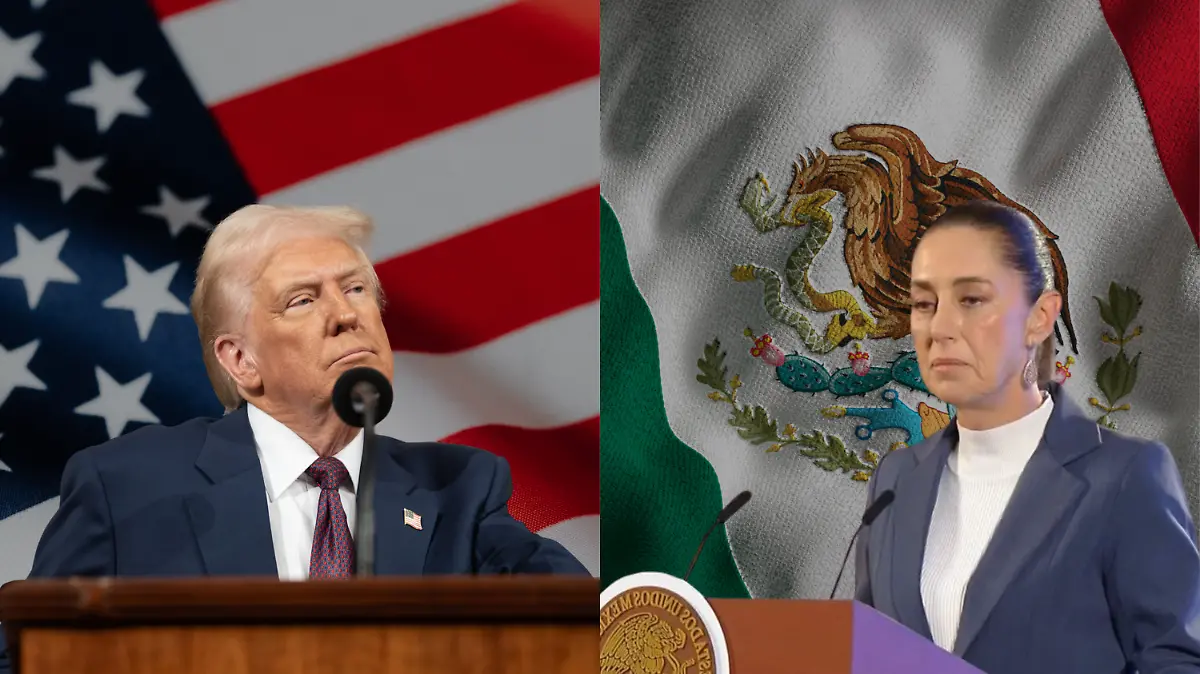
President Donald Trump’s statements regarding the possibility of the United States taking more aggressive measures against the Sinaloa Cartel and other criminal groups in Mexico have generated concern and debate in both Mexico and Washington, intensifying the discussion about security cooperation and national sovereignty.
During a recent interview, Trump stated that U.S. forces could begin ground attacks against the cartels, arguing that these groups have “significant control” in various parts of the country and represent a direct threat to U.S. security. The president has even suggested that he does not need congressional authorization to act and has maintained that the cartels “are running Mexico.”
The U.S. president’s rhetoric has hardened in recent weeks, as he insists that current actions are insufficient and that Washington must act more forcefully against criminal organizations operating in Mexican territory, including the Sinaloa Cartel, which he has repeatedly mentioned.
These statements come at a particularly sensitive time for Sinaloa. Since late 2024 and throughout 2025, the state has experienced surges in violence linked to internal disputes within organized crime, with episodes of armed clashes, road blockades, bomb attacks, and recurring federal operations, primarily in Culiacán and municipalities in the south.
In this context, the Sinaloa Cartel continues to be identified by U.S. authorities as one of the criminal organizations with the greatest operational capacity, territorial presence, and international reach, despite arrests and seizures made in recent years. For the local population, the group’s continued presence translates into daily uncertainty, disruptions to daily life, and a persistent sense of insecurity.
The threat of potential direct intervention by the United States has put Mexico on alert regarding the legal, diplomatic, and sovereignty implications of unilateral action on national territory.
Mexican President Claudia Sheinbaum emphatically rejected any foreign military intervention. She emphasized that national sovereignty is “inviolable” and that cooperation with the United States must occur exclusively within the legal framework and with mutual respect. Sheinbaum noted that security coordination mechanisms already exist that allow for confronting criminal groups without resorting to unilateral actions.
The governor also stated that Mexico will not accept military operations on its territory without its express consent, warning that any such action would represent a serious violation of international law.
To date, neither the United States nor Mexico has announced joint operations in Sinaloa or concrete measures to implement the strategy proposed by Trump, which maintains uncertainty as to whether the US president’s threats will translate into real action or remain merely political rhetoric.
Source: oem