
The return of Rubén Rocha will go down in the records as, among many other things, the briefest period during which a governor remained in office. It lasted barely 33 hours between his first tweet, announcing that he was returning to the governorship of Sinaloa, and his last one, in which he stepped aside by requesting an indefinite leave of absence. But over the course of little more than a day, almost all the variables of his six-year term came together: the challenge to and testing of the power of President Claudia Sheinbaum and the rest of the federal government’s levers, from the Secretariat of the Interior, a leviathan with a thousand arms, to the Attorney General’s Office (FGR). Morena’s unity, that large family that does not always get along, and its ability to respond to and overcome the blow dealt by one of its political heavyweights. In the background, as secondary actors, the shadows of organized crime and the threatening gaze of the United States. Below, EL PAÍS reconstructs, through testimonies from half a dozen sources involved in the negotiations, the sequence of events during an explosive political day.
Friday, August 21, begins without many twists in the official agenda. The president leads, as she does every day, the Security Cabinet meeting at exactly 6:00 a.m. The only unusual thing so far is that Sheinbaum barely has a voice. An untimely bout of flu has left her almost hoarse. Since the day appears calm, and because she needs to recover in order to finish recording the spots for her Second Government Report the following day, she entrusts Rosa Icela Rodríguez once again with leading the morning press conference and makes it public on social media. The Secretary of the Interior conducts an uneventful conference focused on routine issues, such as the budget of political parties and the INE, as well as the discovery of pre-Hispanic caves in Chiapas. At 9:18 a.m., the morning press conference concludes.
09:46. Rubén Rocha publishes his first tweet. He announces his return to the governorship in a text several paragraphs long. His argument is that, following the U.S. Department of Justice’s accusation of drug trafficking and the more than three months of investigation by the FGR, “there are no minimum elements of evidence to substantiate our participation in any criminal conduct.”
The announcement lands like a bombshell at the National Palace. No one had informed them of Rocha’s decision, with whom communication had been maintained through his circle despite the temporary leave that had removed him from office. The president’s anger is at its highest. She once again entrusts the Secretary of the Interior with the mission of putting out the fire. Rodríguez picks up the phone and calls Rocha and those around him several times. There is no answer. They do not even take her calls.
With communication channels cut off, the Interior Ministry begins activating the institutional machinery to coordinate a response: the cabinet, the prosecutor’s office, governors, and congressional chambers. It is agreed that an initial message should be sent establishing the government’s position. Hours pass as the final wording of the statement is agreed upon between Bucareli and the National Palace. Sheinbaum personally supervises every paragraph.
13:28. The Secretariat of the Interior issues a statement asserting that Rocha’s decision “responds exclusively to a personal determination,” while also stating that the FGR’s investigation files related to him and nine former Sinaloa officials sought for extradition by the United States remain open.
From that moment, a direct communication channel with Rocha is opened through a single intermediary. It is not an official negotiation, but a dialogue begins in which he is urged to reconsider his decision, while also being warned that there is a full willingness to activate all institutional resources to remove him from office.
The governor’s response is calm, but negative. This is despite being made aware of the president’s total disagreement, as she attends a virtual meeting with the Mexican Social Security Institute (IMSS) around noon. Director Zoé Robledo shares a photograph of the meeting, showing President Sheinbaum working in her office wearing a face mask. Hours later, Robledo removes the post from his social media accounts.
Throughout the afternoon, statements from more political actors follow one after another. Morena’s national leadership distances itself from the governor’s decision: “Rubén Rocha Moya’s decision to return to office is personal.” Ariadna Montiel, the party’s president, reposts it on her social media. Citlalli Hernández, president of the National Elections Commission, shares Morena’s statement with a comment: “In our movement, we have been clear: no one is above the law. We will respect due process and the investigations being carried out by Mexican authorities.”
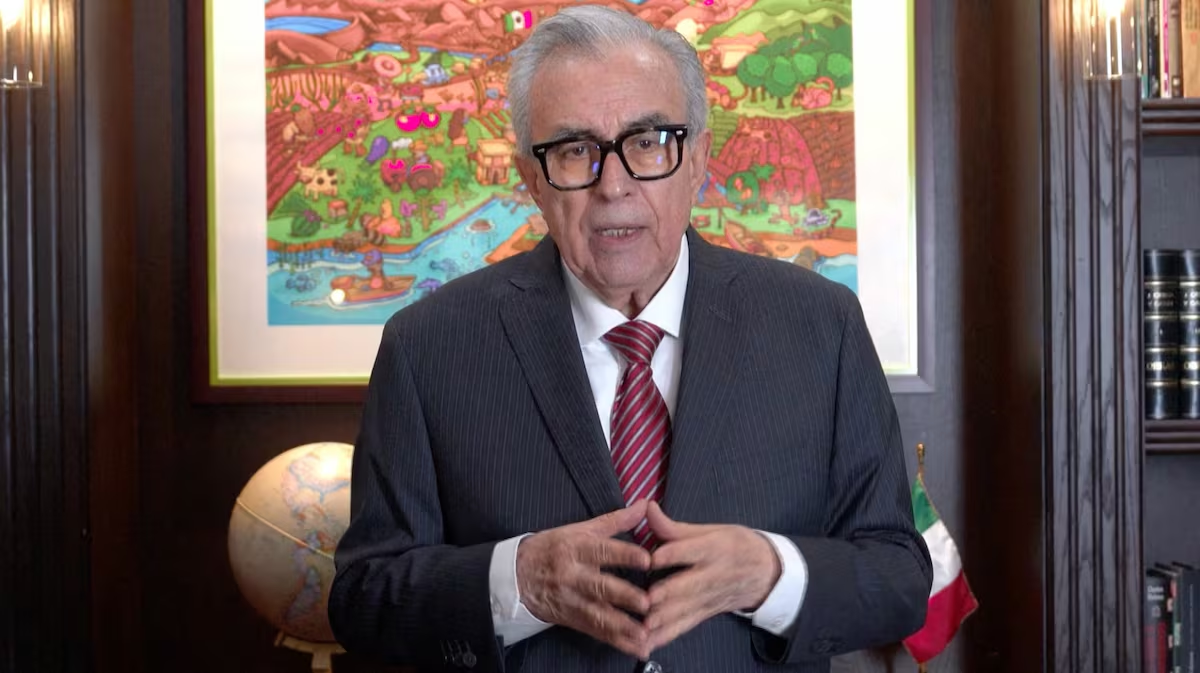
15:23. Rubén Rocha releases a video in which he already appears in his office at the Sinaloa Government Palace. The governor has ignored calls from several fronts. “Here I am, and we are going to continue governing with firmness and dedication for our homeland, Sinaloa.”
The afternoon progresses and pressure continues for Rocha to step aside. Morena’s federal deputies’ coordinator, Ricardo Monreal, insists that the decision was individual and adds: “We reaffirm our firm support for President Sheinbaum.” Deputy Alfonso Ramírez Cuéllar, one of President Sheinbaum’s closest legislators, criticizes the decision and adds: “immunity is an enormous national disgrace.” Morena’s Senate caucus issues a brief statement distancing itself from the governor’s “personal and individual act.”
17:18. Rocha issues another statement, accompanied by a photograph with his cabinet: “Sinaloa has a team focused on addressing the priorities of families. Together with my cabinet, we reaffirm the commitment we made since 2021: to profoundly transform Sinaloa.” It is his third and final challenge on social media.
Direct communication with the governor continues to insist that he take another leave of absence in order not to deepen the crisis. In the media and on social networks, attention turns to Palenque as the alleged origin of the Sinaloan’s defiance. The silence of former President Andrés Manuel López Obrador, his son Andy, and his closest associates, such as his former spokesman Jesús Ramírez Cuevas or his former Secretary of the Interior, Adán Augusto López, fuels speculation. Luisa Alcalde, Morena’s former president and current legal adviser to the Presidency, also says nothing. Those silences will forever place the episode within a framework of mystery: Did Rocha consult in Palenque about the decision that the National Palace learned about through Twitter? Does his return imply a rupture between López Obrador and Sheinbaum? The opposition claims so and gives free rein to that narrative. The sources consulted categorically deny it. Sheinbaum would later call it “political fiction.”
Government-aligned spokespeople raise the tone. Manuel Velasco, coordinator of the Green Party in the Senate, announces that his party neither shares nor supports Rocha’s personal decision. Arturo Ávila, spokesman for Morena’s federal deputies, announces a statement from the parliamentary group urging Rocha to reconsider his decision and request leave again.
18:30. The 23 governors from the governing coalition, including the governor of San Luis Potosí from the Green Party, publish a statement calling for maturity and responsibility from Rubén Rocha and declaring: “We express our absolute and categorical support for the President of the Republic.” The statement first appears on the accounts of Marina del Pilar of Baja California and Alfonso Durazo of Sonora; the other signatories gradually join in. Only Salomón Jara of Oaxaca stumbles, invoking the discourse of defending national sovereignty that the Fourth Transformation has used since May to support the Sinaloan governor.
By 7:00 p.m., Rocha is left alone, isolated with his small group in Culiacán. The operation from the Interior Ministry has borne fruit. All institutional actors have closed ranks behind the president. Their attitude throughout the day has been one of “subordination,” without cracks, according to the sources consulted. Even the government’s satellites have climbed aboard without reservations. Karen Castrejón, national leader of the Green Party, distances her party from Rocha and states “that the public interest must prevail.” The Labor Party also speaks out, through the Senate caucus led by its patriarch, Alberto Anaya, in support of Sheinbaum. They state that they will remain attentive to information arising from the FGR investigations.
As the finishing touch to a frantic Friday, late in the afternoon U.S. media publish statements from a State Department spokesperson reacting to the crisis surrounding Rocha’s return: “The Sinaloa Cartel could not operate without the help of corrupt officials.”
Saturday. 10:39. President Sheinbaum breaks her silence in a harsh tweet. “No personal interest can ever be placed above the interests of the people and the Nation. Much less when what one seeks to place above Mexico is not the well-being of its people, but the naked ambition of power for the sake of power.”
More than 24 hours after the crisis began, Rocha remains entrenched, and the president appeals to the founding principles of Morena with all the rhetoric characteristic of the great rallies inherited from Andrés Manuel López Obrador. “Mexico deserves public servants who understand that positions are temporary, but responsibility before the Nation is eternal. The People are not here to feed personal ambitions. Above any name, any group, and any particular interest stand the people and the Nation.”
11:22. Morena President Ariadna Montiel reposts Sheinbaum’s tweet with an addition: “One conviction must always prevail: the people and Mexico are above everything. The Transformation is built on principles, responsibility, and loyalty to the Nation.”
Rocha begins to realize that he will not be able to sustain his gamble. During the direct communication that began the previous day, the governor explains that his decision was based on a kind of fait accompli strategy. First, return to office. Then convince the president, the party, and the other institutions. His interlocutor insists that no concessions will be made. The possibility is even raised that everything is prepared to push the button on impeachment proceedings against the governor, a route that had already begun a couple of months earlier with a formal request in the Chamber of Deputies by the PRI.
18:40. Rocha gives in and announces his new leave of absence in a brief three-paragraph statement addressed to the Sinaloa Congress, specifying that he is requesting a “temporary leave of absence of an indefinite nature for more than 30 days.”
The president has won the battle, and that same night orders the next steps: find an interim governor who is not one hundred percent loyal to Rocha and bring forward the announcement of the state coordination for the defense of the Transformation in Sinaloa, which obviously cannot fall to the Rochista faction.
Rosa Icela Rodríguez, Ariadna Montiel, and Citlalli Hernández once again enter the scene. The Secretary of the Interior is responsible for controlling the designation of the new interim governor in the Sinaloa Congress, originally summoned for Monday. The session is postponed until the following day while a candidate matching Sheinbaum’s profile is identified: honest, committed to the principles and ideals of the movement, and an interim governor who will complete Rocha’s constitutional term, which officially ended in October 2027. The appointment goes to federal deputy Graciela Domínguez Nava. Although she served as Rocha’s Education Secretary, her previous career and a rapid assessment of her profile within the security cabinet win the president’s approval.
In parallel, the Morena president manages the selection of Senator Imelda Castro as the party’s next candidate for the governorship, which means bringing forward the party’s timetable. To cover the decision, it is first decided to announce three of the 17 states where elections will be held in 2027, those where the candidacies had already been settled: Aguascalientes, Campeche, and Colima. A day later, Querétaro and Sinaloa are announced. Imelda Castro is appointed coordinator at noon on Wednesday, with the support and resignation of a dozen candidates who had entered the internal process, several of them Rochistas, and the backing of the Green Party and the Labor Party. Rocha’s rebellion is now a thing of the past.
Source: elpais